Designing a Scalable AI SaaS Architecture: From core platform to multi-domain products
Introduction
A scalable AI SaaS architecture supports growth without constant rebuilding. It starts with one strong core. Then, teams add products for different markets. Each product can meet unique user needs. However, every product still uses shared platform services.
This model can reduce delivery time and technical risk. It can also improve security and daily control. Yet, a shared core needs careful design. Teams must define boundaries before adding features. They must also keep domain rules outside common services.
At Mysoly, we use this approach across several service domains. Partners bring deep market knowledge. Mysoly owns the shared architecture and its operation. Therefore, each side can focus on its strongest work.
Start with a clear platform core
The core should solve common platform needs once. For example, it can manage identity, access, tenants, logging, and alerts. It can also support billing, files, reports, and integrations.
AI services also belong near this shared core. These services can manage model access and prompt rules. In addition, they can check outputs and record AI actions. A central layer gives teams one control point.
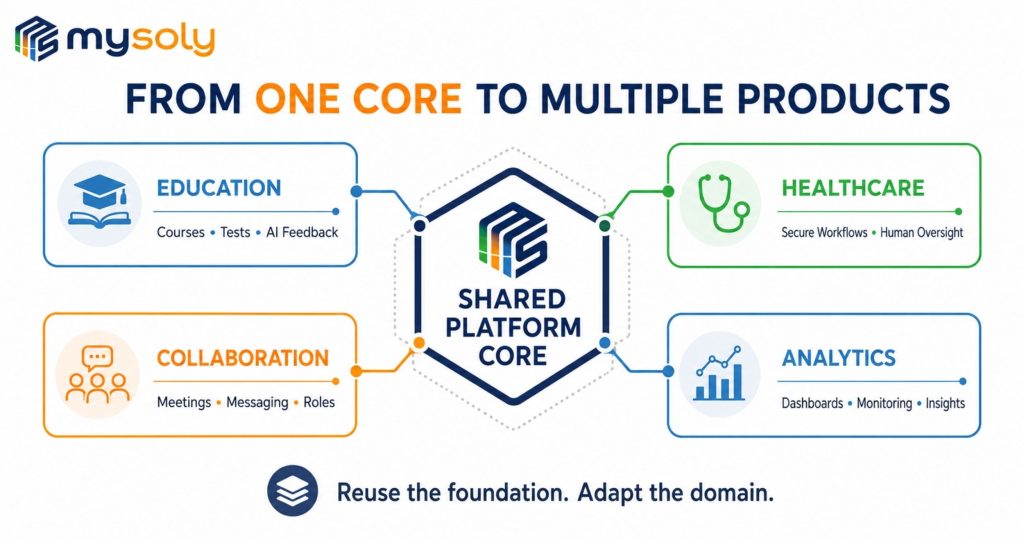
However, the core should not contain every business rule. Healthcare and education use different terms and processes. Therefore, domain logic needs separate modules. This split protects the core from market changes.
A good core offers stable contracts through clear APIs. It also uses events for loose links between modules. As a result, teams can replace one service safely.
Separate shared services from domain modules
A modular SaaS architecture needs clear module ownership. Shared services should support every product. Domain modules should support one market or workflow.
For example, all products may need user roles. Yet, a learning product may need classes and tests. A healthcare product may need care teams and patient consent. These features should not enter the shared identity service.
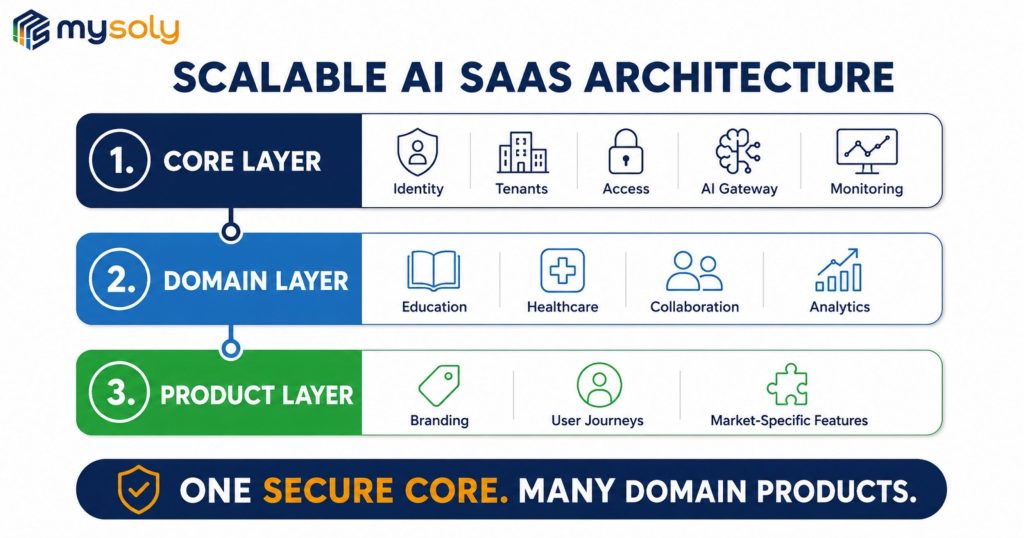
This boundary creates three useful layers:
-
- The core layer manages common platform controls.
- The domain layer manages market rules and workflows.
- The product layer manages branding and user journeys.
Therefore, teams can change a product without breaking the platform. They can also reuse proven services across new products. This pattern supports faster product work and safer updates.
Carry tenant context through every service
Multi-domain products often serve many organizations. Each organization becomes a tenant. The platform must know the tenant for every request.
Tenant context should start at user sign-in. Then, the platform should pass it through every service. Each data query must use that context. Each log should also include the tenant identity.
AWS SaaS guidance treats tenant isolation as a core SaaS concern. Shared infrastructure alone does not create safe isolation. Therefore, each service must block cross-tenant access.
Teams should avoid manual tenant checks in many code areas. Instead, they should use common access rules. This approach reduces mistakes. It also makes reviews easier.
Some tenants may need stronger isolation. For example, a regulated client may need separate storage. A flexible architecture can support pooled and separate models. However, both models should use one operating system.
Build AI as a controlled platform service
AI features can spread quickly across products. Therefore, teams need one controlled AI layer. This layer should connect products with approved models.
The layer can apply common rules before every request. It can remove sensitive data where needed. It can also select models by risk and cost. Afterward, it can check outputs and store safe records.
Human review remains important for serious decisions. AI should support people, not replace clear responsibility. Therefore, the platform should mark review steps inside each workflow.
Teams should also track model versions. A model update can change quality or risk. So, every AI action needs enough context for later review.
This design also limits vendor lock-in. Products call one internal AI service. That service can route work to different models. Consequently, product teams avoid direct model links.
Design data boundaries before product growth
Data design shapes future platform limits. Teams should classify data before storage. They should know which data identifies people. They should also find health, education, or financial data.
Next, teams should define storage rules for each class. Sensitive data may need stronger access and shorter retention. Analytics data may need pseudonyms. AI training data needs a clear legal and business purpose.
The platform should collect only necessary data. It should also separate operational data from reporting data. Therefore, teams can limit wider access.
Data location also matters. EU clients may require EU hosting and operation. Clear data maps help teams answer these needs. They also support privacy reviews and security audits.
Make operations part of the architecture
Growth creates more users, tenants, and support needs. Therefore, operations cannot remain an afterthought. A scalable AI platform needs useful signals from every layer.
Teams should measure response time, errors, and service use. They should also measure tenant activity and AI costs. These measures help teams find noisy tenants and weak services.
The platform should automate safe scaling. Yet, teams still need cost limits. One busy tenant should not harm others. Rate limits and workload queues can protect shared services.
Mysoly uses central monitoring across platform modules. Administrators can view activity, usage, and performance. As a result, teams can act before users report problems.
Support new domains through repeatable product work
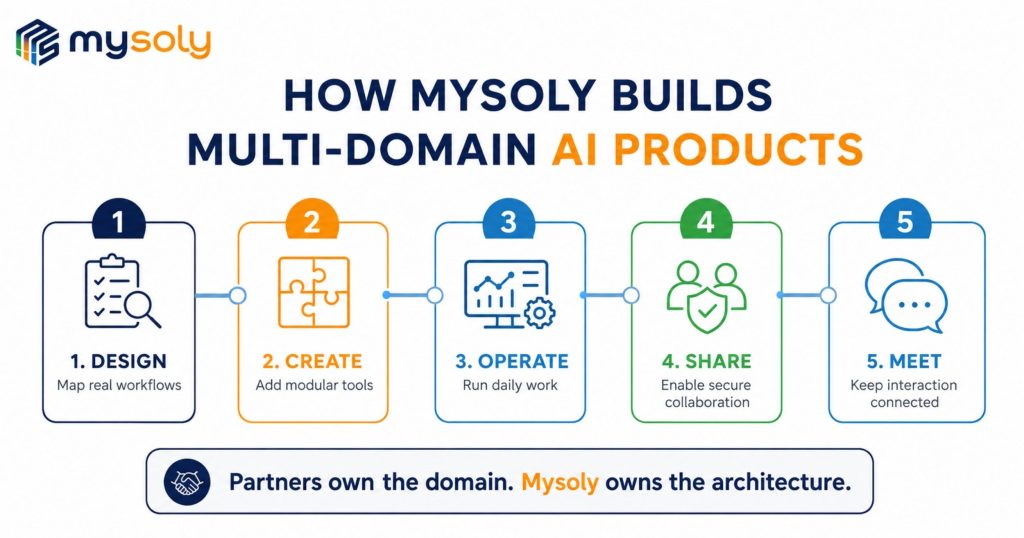
A multi-domain SaaS platform needs a clear product process. First, teams map real domain workflows. Next, they match those workflows with core services. Then, they build only missing modules.
This process avoids two common errors. Some teams copy an old product completely. Other teams build every new product from zero. Both choices create long-term waste.
Instead, teams should create a domain package. It can include modules, access rules, data rules, and reports. It can also include branding and product settings.
Testing should cover the package and the shared core. Therefore, a core update can reach every product safely. Product teams can then release smaller changes more often.
Use governance gates for every platform change
Architecture decisions affect security, privacy, cost, and AI risk. Therefore, teams need simple review gates. A gate should check new modules before release.
The review can ask five questions. Does the module respect tenant boundaries? Does it collect necessary data only? Does it use approved AI services? Can teams monitor it? Can teams remove it safely?
These questions keep platform growth under control. They also create evidence for clients and audits. Moreover, they help new developers understand design rules.
Governance should live inside delivery work. It should not sit in a separate document. Automated tests can check many rules. Human reviewers can handle context and risk.
Conclusion
A scalable AI SaaS architecture needs more than cloud resources. It needs stable boundaries, shared controls, and strong operations. The core should manage common services. Domain modules should manage market needs. Product layers should shape each user journey.
This model helps partners enter new markets faster. It also keeps security and governance consistent. At Mysoly, one proven core supports many products. Therefore, partners can focus on their domain and growth.
The best time to set these rules is early. Clear boundaries now can prevent large rebuilds later. A scalable AI SaaS architecture turns platform work into lasting business value.
FAQ
What is a scalable AI SaaS architecture?
It is a platform design that supports more users and products. Teams reuse shared services across many product lines. They keep domain rules in separate modules. Therefore, growth does not require a full rebuild.
How do you design a multi-domain SaaS platform?
Start with common services, such as identity and tenant control. Next, separate domain workflows into clear modules. Use stable APIs between these parts. Finally, add product settings for branding and user journeys.
Which services belong in an AI SaaS platform core?
The core often includes identity, access, tenants, logging, and monitoring. It may also include files, billing, notifications, and integrations. AI gateways and output controls also fit there.
How does modular SaaS architecture reduce technical risk?
Modules limit the effect of each change. Teams can test one part alone. They can also replace weak services more safely. Shared controls reduce repeated code and common security mistakes.
How can AI SaaS products avoid vendor lock-in?
Use an internal AI service between products and model providers. Keep model rules inside that service. Then, products can change providers without major product code changes.