From MVP to Enterprise AI Platform: How to scale AI products without rebuilding everything
Introduction
Many teams build an MVP for speed. Then, enterprise clients ask for control and trust. The product may need roles, audits, and tenant isolation. It may also need stronger performance and support.
Teams often think they must rebuild everything. However, a clear path can protect useful MVP work. The key involves stable boundaries and planned replacement.
Mysoly uses one proven platform core across several products. Therefore, partners can scale an AI SaaS platform without starting from zero.
Know when the MVP has reached its limit
An MVP should test a problem and a solution. It should not solve every future need. Yet, teams must see when speed starts creating risk.
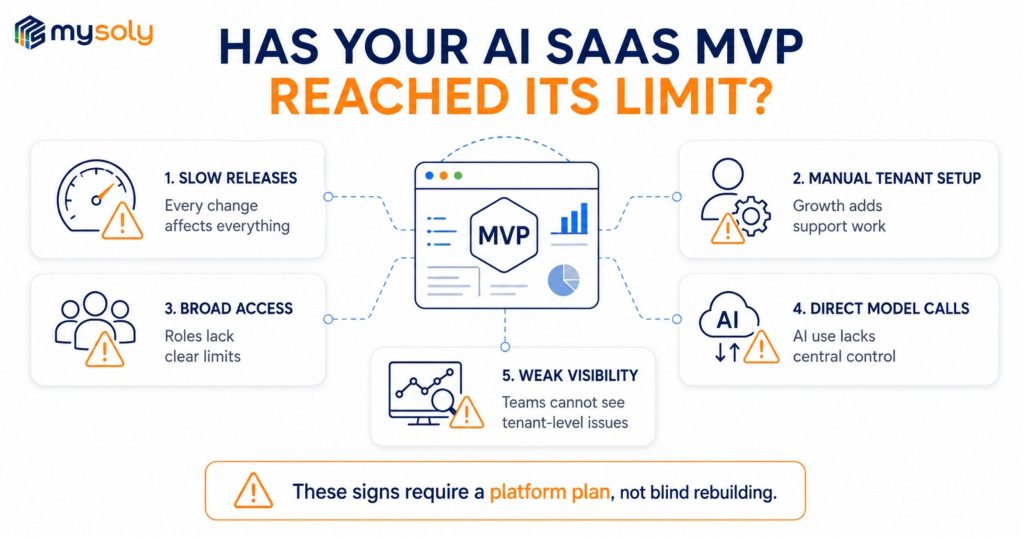
Common warning signs include slow releases and repeated errors. Manual tenant setup also creates concern. Broad administrator access creates serious risk.
AI features may use direct provider links. Data may spread across prompts and logs. In addition, teams may lack model or prompt versions.
Performance problems offer another warning. One large client may slow every user. Support teams may lack tenant-level signals.
These signs do not always require a full rewrite. They require a clear platform plan.
Define the enterprise target before changing code
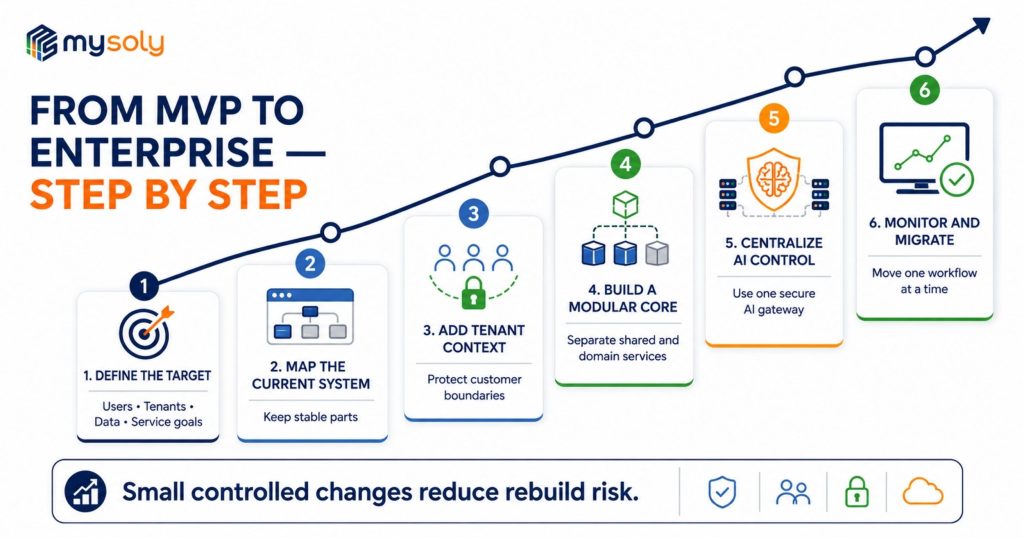
Teams should define the future operating model first. They need to know expected tenants, users, and data types. They also need service and support goals.
Regulated clients may need audit evidence and stronger isolation. Global clients may need region choices. Large clients may need single sign-on and custom roles.
The target should include product and operating needs. For example, who creates tenants? Who reviews access? Who handles model failures?
A short target map can guide every change. Without this map, teams may replace working code without value.
Find stable parts and weak boundaries
Most MVPs contain useful product knowledge. The user journey may work well. Core business rules may also remain valid.
Teams should keep stable parts where possible. They should first replace weak boundaries. Direct database access and direct model calls often need early work.
Start by mapping current services and data flows. Mark shared code, domain code, and outside links. Then, identify areas with high change or risk.
This map supports a step-by-step plan. It also helps teams avoid a large hidden rewrite.
Create a modular platform core
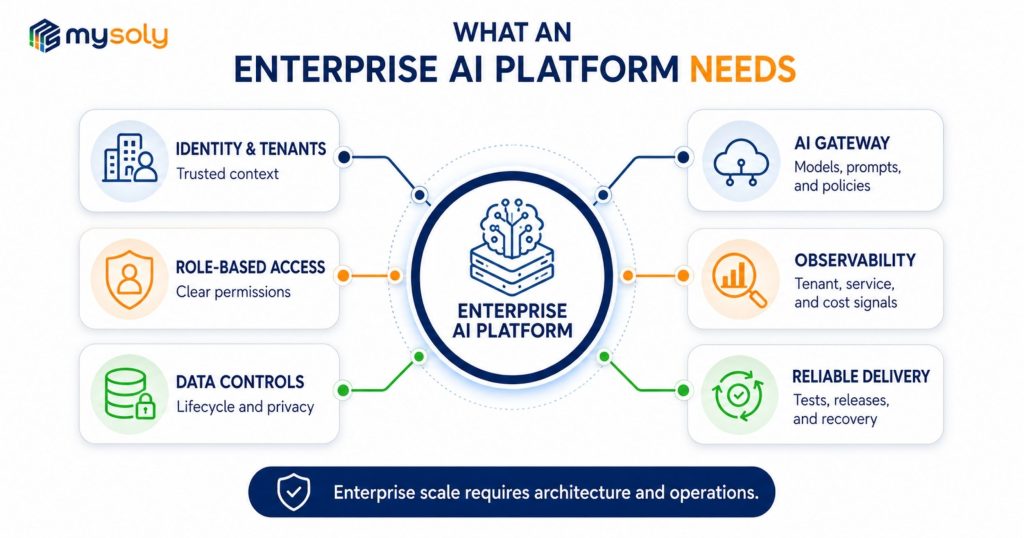
An enterprise AI platform needs common services. These services often include identity, tenants, access, logging, and monitoring. Notifications, files, and billing may also belong there.
Domain features should remain separate. For example, course tasks should not live inside identity. Care workflows should not live inside billing.
Clear APIs connect these modules. Events can connect work that does not need instant replies. Therefore, one module can change with less effect.
Mysoly adds domain modules to a shared core. This approach shortens product work. It also keeps security and operations consistent.
Add tenant context before major growth
Single-client MVPs often lack tenant design. Adding tenants later can touch every query and file. Therefore, teams should introduce tenant context early.
Tenant context should start at identity. It should pass through services, jobs, logs, and data stores. Every resource should have clear tenant ownership.
Teams can migrate data in stages. First, add tenant fields and checks. Next, test cross-tenant access. Then, move clients into managed tenant spaces.
Some clients may need separate databases. Others can use pooled storage. A shared control layer can manage both models.
Move AI access behind one gateway
MVP teams often call model providers from product code. This method supports quick tests. However, it creates weak control at scale.
A central AI gateway can manage approved models. It can also apply tenant rights, prompt rules, and data controls. Product features then call one internal service.
The gateway should record model and prompt versions. It should also control cost and request size. Output checks can protect users and workflows.
This change supports model replacement. It also supports different models by task or tenant. Therefore, the product code stays more stable.
Build a safe data lifecycle
Enterprise clients ask where data goes. They also ask who can access it. Teams need clear answers supported by system design.
Map data from collection to removal. Classify sensitive fields and derived data. Separate operational, analytics, and AI stores.
Set retention rules for logs, prompts, and outputs. Automate deletion where possible. Also, test backup recovery and data rights requests.
Data protection by design should guide every new flow. This approach helps teams meet privacy duties. It also reduces future migration work.
Replace manual work with safe platform operations
Manual processes may support five clients. They rarely support hundreds. Tenant setup, role changes, and feature settings need controlled tools.
An intelligent admin panel can centralize this work. It can manage tenants, packages, roles, and branding. It can also show usage and system health.
Automation needs boundaries. High-risk actions may require approval. Changes should create safe audit records.
Self-service can reduce support work. However, safe defaults should guide tenant administrators. Clear limits prevent accidental platform damage.
Add observability before performance tuning
Teams cannot improve what they cannot see. Therefore, monitoring should come before large performance changes.
Measure response time, errors, and resource use. Break these measures down by tenant and service. AI token use and model time also matter.
Tracing can show slow service links. Tenant measures can reveal noisy neighbors. Cost measures can reveal weak AI workflows.
Afterward, teams can add queues, caches, and scaling rules. They can solve real limits instead of guessed limits.
Change the platform in small steps
Large rewrites often delay user value. They also create a long gap without feedback. A gradual approach reduces these risks.
Teams can place new services around the MVP. They can route one workflow at a time. Feature flags can control release to selected tenants.
Each step needs tests and a return plan. Teams should compare old and new results. They should also watch performance and errors.
This pattern keeps the product available. It also lets enterprise clients test changes safely.
Raise testing and release standards
Enterprise scale requires repeatable quality. Every service needs automated tests. Tenant isolation needs direct attack tests.
AI features need evaluation sets and quality limits. Teams should test model, prompt, and workflow changes together. Human experts should review serious use cases.
Load tests should include several tenant sizes. Security tests should cover APIs, files, and background jobs. Recovery tests should prove backup value.
Release pipelines can block weak changes automatically. Human approval can cover high-risk AI and data work.
Prepare teams and ownership for enterprise work
Architecture alone cannot create enterprise service. Teams need clear ownership and response duties.
Each service needs an owner. Each AI use needs a business owner. Security and privacy decisions also need named responsibility.
Support teams need useful tenant information. Product teams need feedback from incidents and client reviews. Leadership needs cost and risk signals.
Clear ownership reduces slow decisions. It also supports audits and client trust.
Conclusion
Teams can scale an AI SaaS platform without a complete rebuild. They should first define the enterprise target. Then, they should improve weak boundaries.
A modular core supports common services. Tenant context protects customer spaces. An AI gateway controls models and data. Monitoring guides real performance work.
Mysoly uses this approach to turn one architecture into many products. Therefore, partners keep product knowledge while gaining enterprise controls. The safest way to scale an AI SaaS platform involves planned, small changes.
FAQ
How do you scale an AI SaaS platform?
Define the target operating model first. Add tenant context and common platform services. Move AI access behind a gateway. Then, improve monitoring, tests, and release controls.
Should an AI startup rebuild its MVP for enterprise clients?
Not always. Teams should keep stable product parts. They can replace weak boundaries in stages. A full rebuild only makes sense when core design blocks safe change.
What features does an enterprise AI platform need?
It needs identity, tenant isolation, role access, and audit records. It also needs data controls, AI governance, monitoring, and reliable support processes.
When should a SaaS product add multi-tenancy?
Add tenant context before many customers share the system. Early work costs less. Late work can affect every query, file, job, and log.
How can teams scale AI features safely?
Use one controlled AI gateway. Version models and prompts. Test full workflows and monitor quality. Keep human review for high-impact actions.