Building a Multi-Tenant AI SaaS Platform: Isolation, security, and performance at scale
Introduction
A multi-tenant AI SaaS platform serves many customers through one system. This model can lower cost and speed up updates. However, it also creates shared risks. One weak access rule can affect many tenants.
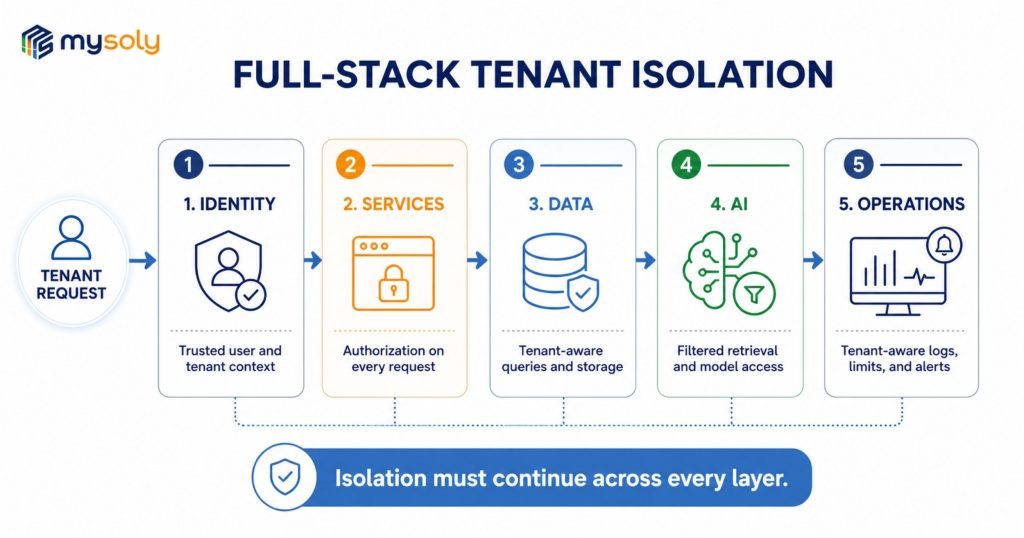
Strong multi-tenancy starts with identity and tenant context. It continues through services, data, AI, and monitoring. Therefore, isolation cannot depend on one database filter.
Mysoly builds platforms around this full-stack view. Each request carries a tenant identity. Each service applies clear access rules. In addition, central monitoring shows platform and tenant activity.
Understand what tenant isolation means
Tenant isolation blocks one tenant from another tenant’s resources. It covers data, files, messages, reports, and AI context. It also covers background jobs and system logs.
Authentication alone does not create isolation. Authentication proves a user identity. Authorization decides which resources that user can reach. Therefore, every request needs both user and tenant checks.
AWS calls tenant isolation a basic SaaS concern. Shared services can still provide strong isolation. Yet, teams must apply tenant rules across every layer.
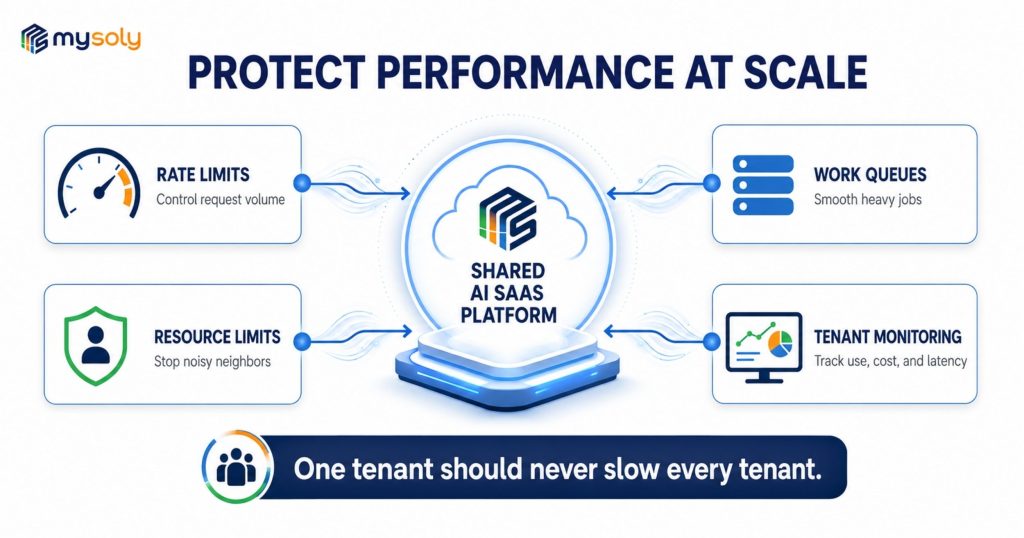
Isolation also protects performance. One tenant should not use every shared resource. So, good isolation includes rate limits and workload limits.
Put tenant context inside identity
The platform should assign users to approved tenants. It should also define their roles inside each tenant. A user may hold different roles in different organizations.
After sign-in, the platform can issue a short-lived token. That token should include trusted tenant claims. Services should verify the token before each action.
Do not trust a tenant identifier from a form alone. A user can change form values. Instead, services should compare each request with trusted identity claims.
Tenant context should travel through APIs and events. Background workers also need that context. Therefore, logs and traces should record the same tenant identifier.
This pattern keeps tenant rules visible and testable. It also limits repeated code across services.
Choose the right data isolation model
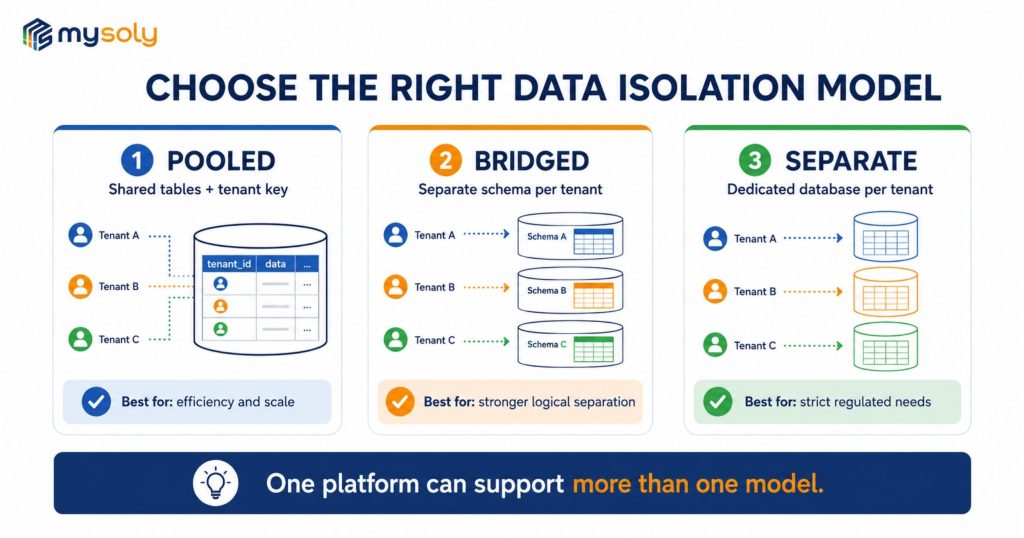
Teams can use pooled, bridged, or separate storage. No single model fits every customer.
A pooled model stores tenant data in shared tables. Every record includes a tenant key. This model offers low cost and simple scaling. However, query controls must remain strict.
A bridged model gives each tenant a separate schema. It offers stronger logical separation. Yet, schema updates need careful automation.
A separate model gives a tenant its own database. It can support strict client needs. However, it costs more and adds operational work.
A multi-tenant architecture can support several models. Teams may place small tenants in a pool. They may give regulated tenants separate storage. Still, all tenants should use one management process.
Enforce isolation beyond the database
Tenant data also appears outside main storage. It may enter caches, search indexes, files, queues, and backups. Therefore, every storage system needs tenant-aware keys.
Cache keys should include the tenant identifier. File paths should use protected tenant namespaces. Search queries should apply tenant filters at the service layer.
Message queues need tenant context too. Workers should reject messages without valid context. They should also limit retries and record failures.
Backups require equal care. Teams should control who can restore data. They should also test tenant recovery. A full backup does not guarantee safe tenant recovery.
Keep AI context inside tenant boundaries
AI can create new isolation risks. A prompt may include private records. A shared vector store may return another tenant’s content. Model logs may also store sensitive text.
Therefore, AI retrieval must apply tenant rules before search. Each document needs clear tenant ownership. The vector index should enforce that ownership during every query.
The AI gateway should block direct model access. It can apply redaction, policy checks, and output controls. It can also record model versions and request purpose.
Mysoly keeps human oversight inside AI workflows. The system can support decisions. However, people keep final control over serious actions.
Teams should also define data use with model providers. They should disable training use where needed. Moreover, they should avoid sending unnecessary personal data.
Use role-based access with clear limits
Tenant isolation answers one question. Which organization owns this resource? Role access answers another question. Which action may this user take?
Common roles may include owner, manager, teacher, reviewer, and member. However, role names alone can become too broad. Teams should map each role to exact actions.
Sensitive actions may need extra checks. For example, exports may require manager approval. Role changes may require strong login steps.
The platform should deny access by default. It should grant only necessary rights. This rule reduces accidental access and insider risk.
Access reviews should happen often. Old users and unused roles create hidden risk. Therefore, tenant administrators need simple review tools.
Protect platform performance at scale
Shared systems create a noisy-neighbor risk. One tenant can send many requests. Another tenant may then face slow service.
Rate limits can control request volume. Work queues can smooth heavy jobs. Resource limits can protect databases and AI services.
Teams should also measure use by tenant. Useful measures include request count and response time. AI token use and storage growth also matter.
These measures support fair limits and pricing. They also show weak product patterns. For example, one workflow may create too many model calls.
The platform should scale common services automatically. Yet, automatic scaling needs cost controls. Otherwise, one error can create a large cloud bill.
Monitor security with tenant-aware signals
General logs cannot explain every SaaS issue. Teams need tenant-aware logs, traces, and measures. Every signal should include a trusted tenant key.
Security teams can then find unusual exports or login patterns. Operations teams can compare response times across tenants. Support teams can solve problems faster.
However, logs can hold personal or sensitive data. Therefore, teams should limit log content. They should also control log access and retention.
Alerts should show the affected tenant and service. They should not expose private content. Good alerts help teams act quickly without wider data access.
Test isolation as a product feature
Teams should test tenant isolation during every release. Tests should try valid and invalid access paths. They should also cover APIs, files, search, and AI retrieval.
Automated tests can create two test tenants. Then, each tenant can try another tenant’s resources. Every attempt should fail.
Security reviews should also cover background jobs. Many isolation errors appear outside normal user requests. Therefore, teams need full workflow tests.
Load tests should use different tenant sizes. They should include sudden AI workloads. This approach shows noisy-neighbor problems before launch.
Conclusion
A multi-tenant AI SaaS platform needs isolation across the full system. Identity should carry trusted tenant context. Services should enforce access rules. Data systems and AI retrieval should respect the same boundaries.
Security and performance also support each other. Rate limits protect service quality. Tenant-aware monitoring supports fast action. Regular tests prove that controls still work.
Mysoly combines these controls within one scalable platform core. Therefore, partners can grow without losing clear tenant boundaries. A secure multi-tenant AI SaaS platform creates trust at every scale.
FAQ
What is a multi-tenant AI SaaS platform?
It is one software system serving many customer organizations. Each customer uses a separate tenant space. Shared services lower costs and simplify updates. Strong controls keep tenant data and AI context separate.
How do you ensure tenant data isolation in SaaS?
Carry tenant context from identity through every service. Apply tenant rules to databases, files, caches, and queues. Test cross-tenant access during every release. Also, monitor activity with tenant-aware signals.
Is a shared database secure for multi-tenant SaaS?
A shared database can be secure with strict controls. Every record needs a tenant key. Every query needs enforced tenant filtering. High-risk tenants may still need separate storage.
How do you prevent cross-tenant data leaks in AI search?
Assign tenant ownership to every indexed document. Apply tenant filters before retrieval. Block direct index and model access. Finally, test retrieval with documents from several tenants.
How do you improve multi-tenant SaaS performance?
Measure resource use by tenant. Add rate limits and work queues. Scale busy services automatically. Also, protect shared databases with fair workload limits.