AI SaaS Data Architecture: How to handle sensitive data in regulated environments
Introduction
AI SaaS data architecture needs special care in regulated environments. Health and education data can affect real lives. Therefore, teams must protect data across its full journey.
Good architecture starts before storage. It asks why the platform needs each field. It also controls input, processing, output, and removal.
Mysoly builds privacy and security into the platform core. Our systems use tenant isolation and role-based access. In addition, human oversight guides AI use.
Map every sensitive data flow
Teams cannot protect data they do not understand. Therefore, the first step involves a clear data map.
The map should show each data source. It should also show storage, processing, sharing, and removal. AI model calls and analytics tools belong on this map.
Teams should name the owner for each flow. They should record purpose and legal basis. They should also note countries and outside providers.
This map supports privacy reviews and security work. It also helps teams answer client questions. Most importantly, it reveals hidden copies and weak links.
The map should change with the product. A yearly document cannot show daily platform change. Therefore, release work should update the map.
Classify data by risk and purpose
Not all data needs the same protection. Teams should classify data by content and possible harm.
Basic account data may need standard controls. Health data needs stronger limits. Children’s data may need extra care. Free text can also hide sensitive details.
Purpose matters as much as content. A care note supports one purpose. Marketing use creates another purpose. Therefore, teams should avoid broad data reuse.
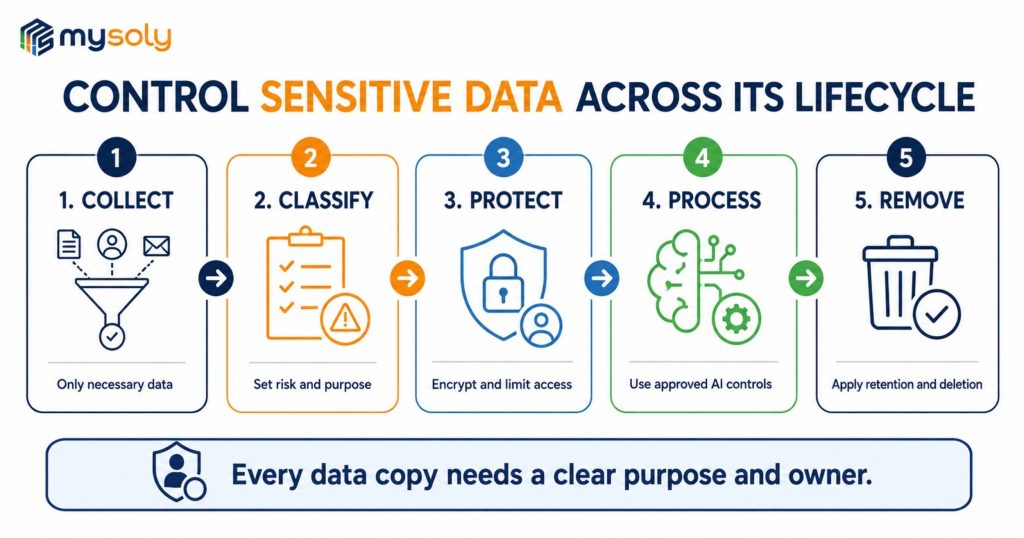
A useful class can define storage, access, retention, and export rules. It can also define whether AI processing can use that data.
Classification should remain simple enough for teams. Too many classes create mistakes. A few clear levels often work better.
Use data minimization by default
Every collected field creates cost and risk. Therefore, platforms should collect only necessary data.
Forms should avoid optional sensitive fields without clear value. APIs should request only needed fields. Logs should not capture full records automatically.
AI prompts also need minimization. Many model tasks need context, not full identity. The platform can replace names with protected references. It can also remove unrelated fields.
The GDPR supports data protection by design and default. The EDPB explains that controllers need effective measures. These measures should protect principles and individual rights.
Minimization also improves system design. Smaller data flows remain easier to test and explain.
Separate operational, analytics, and AI data
One large data store creates wide access. It also makes purpose limits harder. Therefore, teams should separate key data uses.
Operational storage supports live product work. Analytics storage supports trends and reports. AI stores may support search, evaluation, or model improvement.
Each area needs separate access and retention. Analytics often needs fewer personal details. AI search may need small document parts with tenant ownership.
Data movement between areas should follow approved pipelines. Teams should avoid manual exports. Automated pipelines can apply masking and quality checks.
This separation also limits incidents. A problem in analytics should not open live operational records.
Enforce tenant and role boundaries
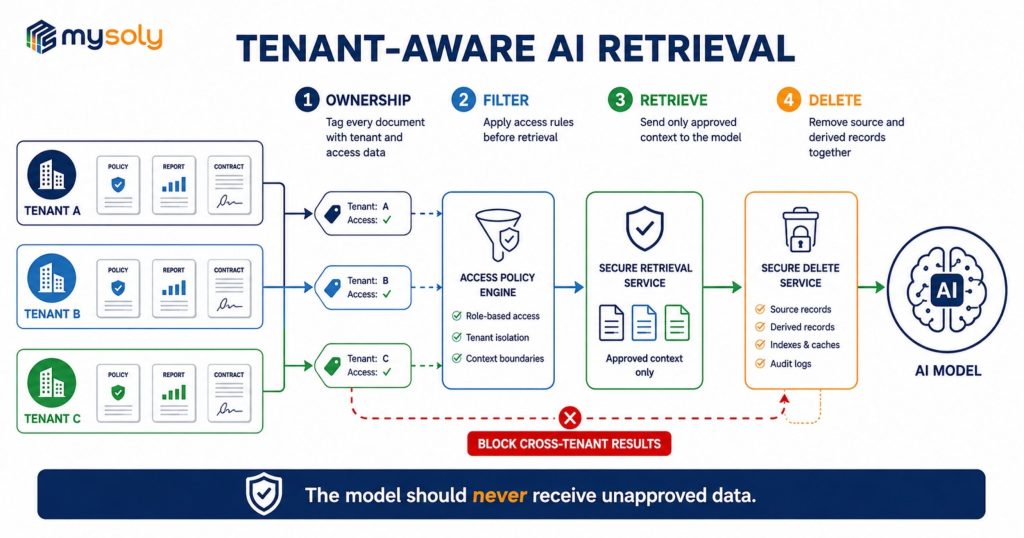
Regulated SaaS platforms often serve many organizations. Each tenant needs a clear data boundary. Roles add another limit inside that boundary.
Every request should carry trusted tenant context. Every data query should apply that context. The platform should also check the user’s exact action rights.
Access should follow least privilege. Users should reach only necessary data. Service accounts need the same rule.
High-risk actions deserve extra control. Exports, role changes, and bulk access may need approval. The system should record these actions safely.
Regular access reviews can remove old rights. Tenant administrators need simple tools for that work.
Encrypt data and manage keys well
Encryption protects data during transfer and storage. Modern transport security should cover every outside and internal link.
Storage systems, backups, and files also need encryption. However, encryption alone cannot fix broad access. Teams still need strong identity and authorization.
Key management needs clear ownership. Keys should rotate through a safe process. Access to keys should remain separate from normal application access.
Some regulated clients may need separate keys. This model can strengthen control. Yet, it also adds recovery and operating needs.
Teams should test key loss and recovery. A secure key without recovery can still stop service.
Control data before and after AI processing
AI systems can expose data through prompts and outputs. Therefore, teams need controls on both sides.
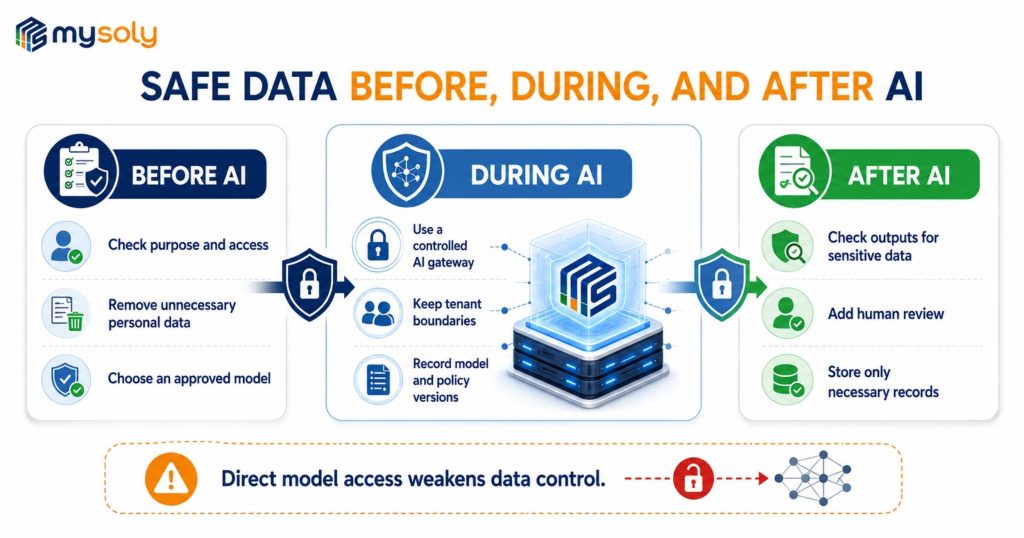
Before processing, the platform should check purpose and access. It should remove unnecessary personal data. It should also choose an approved model and region.
After processing, the platform should check outputs. It should block sensitive leaks and unsafe content. Human review should cover serious results.
The platform should define provider data terms. It should know whether providers keep requests. It should also know whether providers use data for training.
Direct model access makes these controls difficult. A central AI gateway creates one safe route.
Design safe retrieval for AI search
Retrieval systems often split documents into small parts. They then create vector records. These records still need protection.
Each part should keep tenant and access metadata. Search should filter by that metadata before ranking results. The model should receive only approved results.
Teams should avoid one open vector index. They should also test similar document names across tenants. Such tests can reveal weak filters.
Removal must reach the vector store too. Deleting the source alone may leave search copies. Therefore, data lifecycle work must cover every derived record.
Set retention and deletion rules
Data should not remain forever without purpose. Teams need retention rules for each data class.
The platform can automate removal or review dates. It should also handle backups and derived data. AI logs and test datasets need clear limits too.
User rights requests require reliable search and action. Teams should know where personal data lives. They should also verify removal across systems.
Some records may require longer storage. The legal or contract reason should remain clear. Access should become tighter during long storage.
Monitor without creating new privacy risk
Monitoring supports security and service quality. Yet, detailed logs can create a second sensitive database.
Teams should log events, not full private content. They can use protected identifiers and safe error details. Access to logs should remain limited and reviewed.
Alerts can detect unusual exports and access patterns. They can also find AI use outside normal limits. However, alerts should not reveal full records.
Regular tests should check access, restore, deletion, and incident response. GDPR security guidance also expects measures that match the processing risk.
Conclusion
AI SaaS data architecture must control data across its full lifecycle. Teams should map and classify data first. Then, they should minimize collection and separate uses.
Tenant isolation and role access protect daily work. Encryption protects transfer and storage. AI gateways protect model input and output. Retention rules reduce long-term risk.
Mysoly combines these controls within one EU-operated platform foundation. Therefore, partners can build regulated products on clear boundaries. Strong AI SaaS data architecture turns privacy into a working system.
FAQ
What is AI SaaS data architecture?
It is the design for collecting, storing, processing, and removing platform data. It also covers AI prompts, outputs, search records, and logs. Strong architecture links each use with purpose and access.
How should SaaS platforms handle sensitive data?
Map and classify the data first. Collect only necessary fields. Apply tenant and role limits. Encrypt data and set clear retention. Also, test deletion and recovery.
Can an AI platform process health data under GDPR?
It may process health data under strict conditions. The organization needs a valid legal basis and safeguards. It may also need an impact assessment. Legal advice should confirm the exact case.
What is data protection by design?
It means building privacy measures into product and process choices. Teams apply these measures before processing starts. Safe defaults should also limit data and access.
How can AI search protect tenant data?
Keep tenant and access metadata with every search record. Filter results before model use. Test cross-tenant searches often. Also, remove derived records during deletion.
Sources
- EDPB, Data Protection by Design and by Default
- EDPB, Secure Personal Data
- European Union, Regulation (EU) 2024/1689