How to design AI governance into your SaaS platform
Introduction
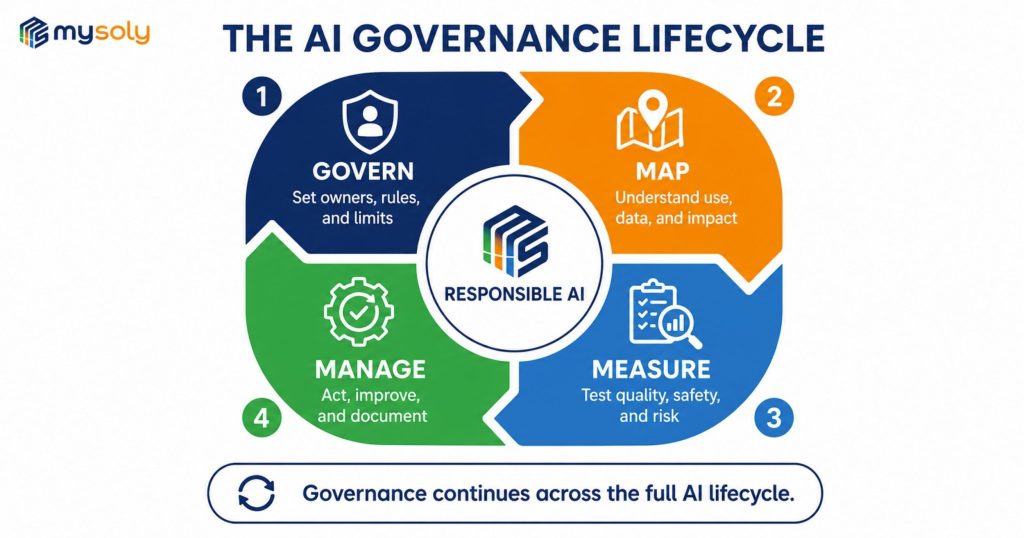
AI governance in SaaS should begin with platform design. It should not start after a complaint. Late controls often create weak fixes and high costs.
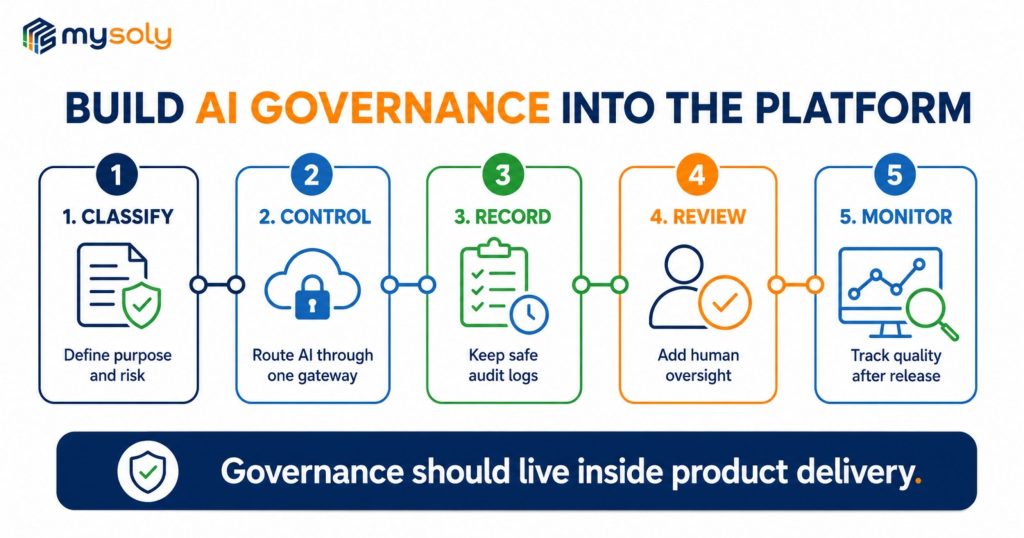
Good governance connects policy with daily product work. It defines who can use AI. It also controls data, models, outputs, and actions. Therefore, every AI feature follows clear rules.
Mysoly places human oversight inside the platform core. AI supports work and analysis. However, people keep responsibility for important decisions.
Turn policy into platform controls
A policy can describe safe AI use. Yet, software must enforce that policy. Teams should translate each rule into a platform control.
For example, a policy may ban sensitive data in public models. The platform can enforce this rule through an AI gateway. Another policy may require human review. The workflow can block final action until review.
This link between policy and code creates clear evidence. It also reduces different behavior across products. Therefore, teams should avoid separate controls for every feature.
A shared governance layer can manage approved models and use cases. It can also store risk levels, owners, and review rules.
Classify AI use cases before development
Not every AI use creates the same risk. A text summary differs from a care decision. Therefore, teams should classify each use case early.
Start with the purpose. Next, identify affected people and data. Then, study possible harm and required review.
A simple risk class can guide design. Low-risk tools may need basic logging. Medium-risk tools may need output checks and human review. High-risk tools may need stronger testing and approval.
The EU AI Act uses a risk-based approach. Requirements change by system type and use. Therefore, teams must assess the real use, not only the model.
Create a central AI gateway
Product teams should not connect directly with many model providers. Direct links create weak control and poor visibility. Instead, teams can use one AI gateway.
The gateway can check user and tenant rights. It can also apply approved prompt templates. Before sending data, it can remove or mask sensitive fields.
After model output, the gateway can apply safety checks. It can block unsafe content or weak formats. It can also record the model and policy version.
This design supports provider changes. Products use one stable internal service. Therefore, teams can test another model without large product changes.
The gateway also supports cost control. It can route simple tasks to smaller models. It can limit request size and daily use.
Keep an AI system registered
Teams need a current list of AI systems and features. This list should cover internal and third-party tools. It should also include trial systems.
Each register entry needs a clear owner. It should state purpose, users, data, model, and risk class. It should also show review dates and known limits.
The register should connect with real platform settings. Otherwise, it becomes an old spreadsheet. Therefore, the platform should update records during release work.
Build audit logs for AI actions
AI audit logs should explain what happened. They should not store every private prompt forever. Teams need useful records with careful data limits.
A useful record may include user, tenant, purpose, and time. It may also include the model version and policy version. For important workflows, it can record review and final action.
Teams should avoid logging raw sensitive data by default. They can store protected references or safe summaries. Access to logs should remain limited.
Logs also need clear retention periods. Some records may support legal or safety needs. Others may lose value quickly. Therefore, one retention rule rarely fits every use.
Design human oversight into workflows
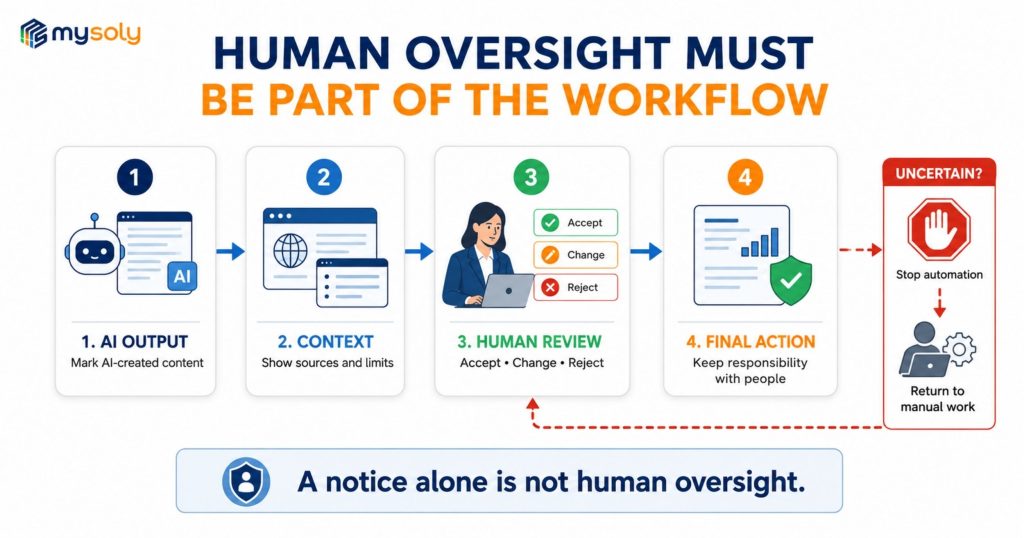
Human oversight needs more than a notice. The product must give reviewers enough information and control. Reviewers should understand the AI output and its limits.
The interface should mark AI-created content clearly. It should also show source information when available. Reviewers need simple actions to accept, change, or reject output.
High-impact actions may need two-step approval. The platform should stop automatic action in uncertain cases. It should also support safe return to manual work.
The EU AI Act includes human oversight duties for high-risk systems. Good design makes that oversight real. It avoids review that only looks formal.
Test models and workflows together
Model tests alone cannot show full product risk. The same model can act differently across workflows. Therefore, teams should test the complete AI feature.
Tests should cover accuracy, harmful output, and data leakage. They should also cover unfair results and weak source use. Domain experts should help create test cases.
Teams need a clear quality threshold. They should define what happens below that threshold. A weak model should not reach users through hope alone.
Model updates require new tests. Prompt changes can also affect results. Therefore, teams should version models, prompts, and policies together.
Add governance gates to delivery
AI review should join normal product delivery. Teams can add a small gate before development. They can add another gate before release.
The first gate checks purpose, data, and risk. The release gate checks tests, logs, review steps, and monitoring. Higher-risk features need stronger approval.
Automated checks can verify approved models and required fields. Human reviewers can study context and possible harm. This mix keeps reviews fast and useful.
Governance teams should not own every AI decision alone. Product, security, legal, and domain teams share responsibility. However, each decision still needs one named owner.
Monitor AI after release
AI quality can change after launch. User behavior may change. Data may also shift. Therefore, teams need regular monitoring.
Useful measures include error rates and review changes. Teams can also track rejected outputs and user complaints. Cost and response time matter too.
Monitoring should work by product and tenant. This view can reveal local problems. However, teams must protect tenant privacy during analysis.
Serious issues need a clear response plan. Teams should know when to pause a feature. They should also know who informs clients and users.
Give tenants clear controls
SaaS customers need control over AI use. They may want different models or risk limits. Regulated tenants may disable some features completely.
An admin panel can manage approved features and roles. It can also set data rules and review needs. These controls should use safe defaults.
Clear reports can show AI use and key actions. They can support client reviews and audits. Moreover, they build trust through visible control.
Mysoly uses a central admin layer for platform governance. Organizations can manage access, branding, and operating rules. This approach keeps governance close to daily work.
Conclusion
AI governance in SaaS works best as platform design. A central gateway can enforce policy. A live register can show system ownership. Audit logs and tests can support review.
Human oversight must also exist inside real workflows. Monitoring should continue after launch. Tenant controls should reflect different needs and risks.
Late governance creates costly changes and weak trust. Early governance supports safer product growth. Therefore, AI governance in SaaS should start before the first model call.
FAQ
What is AI governance in SaaS?
It is the system for controlling AI across a SaaS platform. It covers purpose, data, models, access, testing, and monitoring. It also defines human responsibility and review.
How do you build an AI governance framework?
Start with an AI system register and risk classes. Next, define owners and control rules. Add a central gateway, tests, logs, and review steps. Finally, monitor every released feature.
What should an AI audit log include?
It should include user, tenant, purpose, and time. It should also record model and policy versions. High-impact actions should include review status and final action.
Why does human oversight matter in AI systems?
AI can produce wrong or harmful results. Human review adds context and responsibility. Strong workflows also let people reject output and stop automatic action.
How does the EU AI Act affect SaaS platforms?
The effect depends on the AI use and risk class. High-risk systems face stronger duties. These can include risk management, records, transparency, and human oversight.
Sources
- NIST, AI Risk Management Framework
- NIST, AI RMF Core
- European Union, Regulation (EU) 2024/1689