Multilingual AI feedback systems in learning platforms
The Power of multilingual AI feedback systems
Learning knows no borders. Many students come from diverse language backgrounds, and often, traditional learning platforms do not respond to this diversity. They typically offer feedback in one language. So this is an obstacle for non-native speakers. However, Multilingual AI feedback systems are changing the game with feedback in multiple languages. They help students understand better. Consequently, they make learning more enjoyable. Integrating these systems into learning platforms is a smart move. It ensures every student receives effective support.
Why language is key in education
Language is fundamental to learning. It helps us process new information. It allows us to express our ideas. When language is a barrier, learning suffers, gets harder. Students struggle to grasp even concepts that they would normally get easily. They find it hard to ask questions. Imagine trying to learn a complex subject. If the teaching language is unfamiliar, you feel lost. You don’t know where to go and where exactly you are. This can lead to frustration and giving up the challenge. Therefore, clear communication is vital. Effective feedback must be in a language a student understands. This principle forms the basis for inclusive learning platforms.
The evolution of AI in teaching
Artificial Intelligence has transformed many sectors and education is no exception. AI tools offer personalized learning paths. They give instant feedback. They adapt to individual student needs. For instance, AI-powered tutors assist students. They highlight errors. They suggest improvements. This technology makes learning more efficient. Furthermore, it frees up educators. Teachers can focus on deeper learning activities. AI handles routine assessments. It also provides insights into student progress. Since AI’s capabilities grow, its role in education expands.
Understanding multilingual AI feedback systems
Multilingual AI feedback systems are sophisticated tools. They understand and process multiple languages. They deliver feedback in a student’s native tongue. Let’s think of a student submitting a written assignment. The system analyzes the text. It then offers constructive feedback. This feedback appears in the student’s preferred language. These systems use advanced algorithms. They process linguistic nuances. They generate clear, concise explanations. For example, a student whose first language is French receives feedback in French. A Chinese-speaking student gets feedback in Chinese. Consequently, comprehension dramatically improves. This direct linguistic support enriches the learning experience on learning platforms.
Advantages for learning platforms
Integrating multilingual AI feedback systems into learning platforms offers so many advantages. To begin with, they enhance inclusivity. All students, regardless of their linguistic background, get proper support. Secondly, they boost comprehension. Feedback delivered in the native language is easier to understand. Students learn faster and more effectively. With this, these systems increase student engagement. Students feel more confident. They actively participate in their learning journey. Moreover, teachers benefit from saved time. They do not need to translate every piece of feedback. This allows them to focus on pedagogical tasks. Furthermore, the systems ensure consistent feedback quality. Every student receives equitable and accurate guidance. This consistency builds trust in the learning process. Therefore, these systems are vital for modern education. They make learning platforms more effective for a global audience.
Implementing multilingual AI feedback systems
Successful integration of multilingual AI feedback systems requires careful steps. Firstly, choose a robust platform powerful AI models. The platform must support diverse language capabilities and the models should handle various languages and dialects accurately. Secondly, ensure proper AI training. Use high-quality, multilingual data. This guarantees accurate feedback. Then provide comprehensive training for users. Both teachers and students need to understand the system. And start with a pilot program. Implement the system in select courses initially. Then, scale up gradually. Moreover, collect user feedback regularly. This helps refine and improve the system. Considering technology evolves, continuous updates are necessary. Thanks to this methodical approach, a smooth integration into learning platforms can be achieved.
Overcoming challenges
Integrating multilingual AI feedback systems presents certain challenges. One of the biggests problems is data privacy. This is because student information must be secure. Therefore, implement strong data protection protocols. Another challenge is AI accuracy. AI can sometimes make errors. Human review remains essential for critical feedback. Cost is also a factor. Developing or acquiring these systems can be expensive. However, consider the long-term benefits. Seek cost-effective solutions. Start with core functionalities. Then, expand features as budget allows. Furthermore, provide robust technical support. Users will need assistance with any issues. Since challenges are inevitable, proactive planning is crucial. Addressing these issues ensures effective deployment across learning platforms.
The future with multilingual AI
The future of education is exciting. Multilingual AI feedback systems will play a central role. They will erase language barriers in education. They will make global learning a reality. Imagine a world where language never limits access to knowledge. AI will support every learner. It will provide tailored, instant feedback. Teachers will act as mentors. They will foster critical thinking. They will encourage deep understanding. Furthermore, these systems are developing now and will continue to advance. They will offer more sophisticated insights. They will deliver even more precise feedback. This will lead to superior educational outcomes. So, adopting multilingual AI feedback systems is not just an option. It is a strategic necessity. It builds a brighter future for all learning platforms.
Empowering learning with multilingual AI feedback systems
Multilingual AI feedback systems are truly transformative. They empower students from all linguistic backgrounds. They effectively bridge language barriers. While challenges exist, viable solutions are at hand. By embracing these systems, we cultivate equitable learning environments. Every student gains the opportunity to thrive. They learn in a language they understand best. This boosts their confidence and academic performance. Therefore, implementing Multilingual AI feedback systems is a forward-thinking decision. It ensures learning is accessible, effective, and inclusive for all on our learning platforms.
Supporting learners worldwide
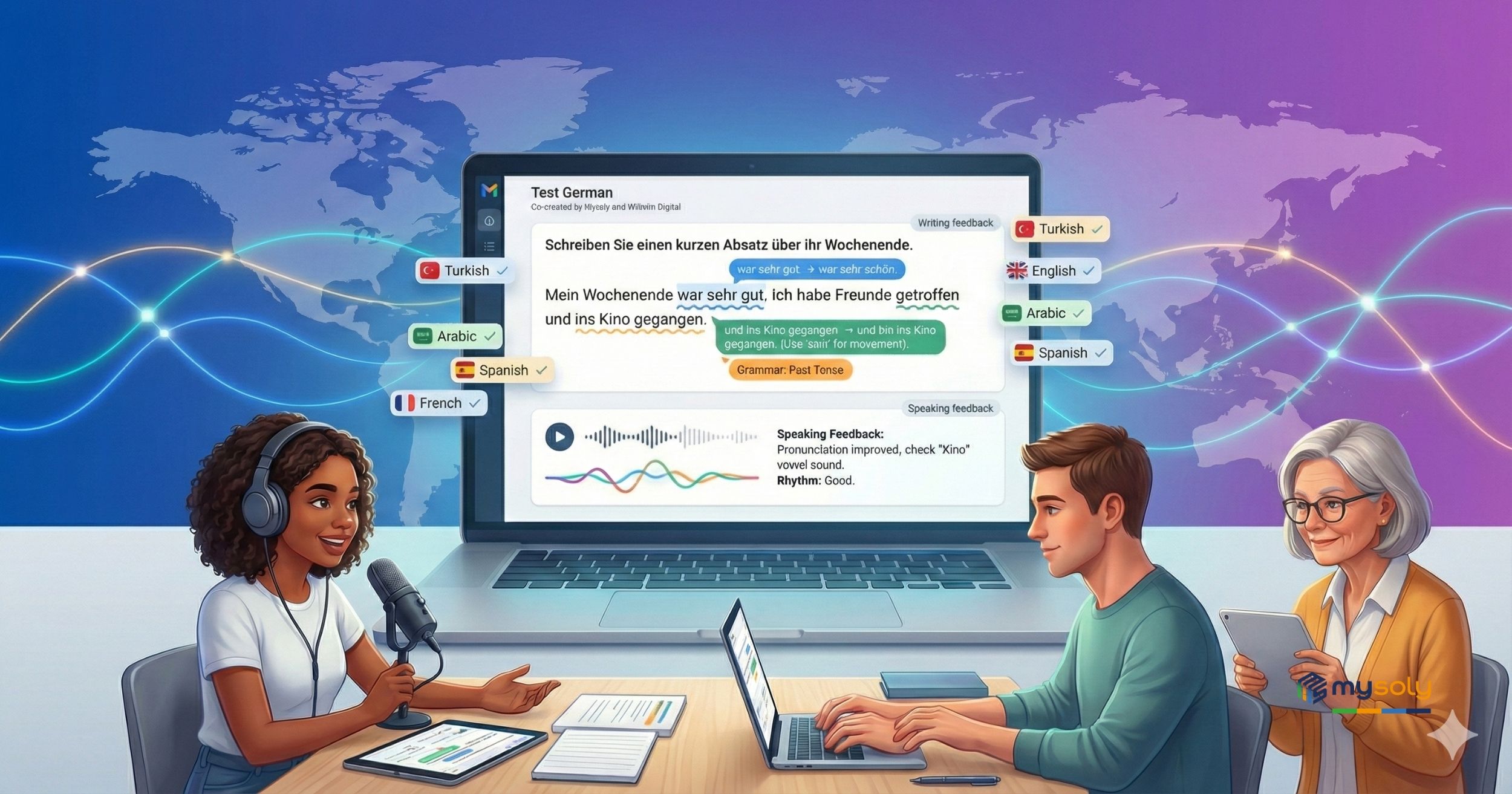
At Mysoly, our mission is to make high-quality learning truly borderless, and multilingual AI feedback systems are at the heart of that vision. Together with Wilhelm Digital, we’ve brought this mission to life in Test German, a joint product designed specifically for high-stakes German exams. Powered by advanced multilingual AI, Test German delivers exceptionally detailed, exam-oriented feedback—especially in speaking and writing, where learners need the most support. Unlike many traditional platforms that stop at generic corrections, Test German explains mistakes clearly, in the learner’s own language, and shows exactly how to improve. United by a shared commitment to accessible, inclusive education, Mysoly and Wilhelm Digital are setting a new standard for how learners prepare for Goethe, telc, and TestDaF—making effective, confidence-building exam preparation possible for everyone, no matter where they come from.